AI pilots are everywhere. Turning them into long-term business value is where things get more complicated.
That was one of the clearest messages to emerge from Digital Transformation Expo London 2026. Across discussions spanning AI, responsible AI, cybersecurity, data analytics, cloud infrastructure, automation and digital transformation, the conversation had moved beyond simply adopting new technology. The bigger questions were about what happens next: How do you move beyond promising pilots? How do you control rapidly growing AI costs? How do you introduce AI agents safely? And how do you make sure people continue to think, learn and apply judgement as AI takes on more of the work?
And while those conversations took place in London, the challenges themselves aren’t limited by geography. Moving AI from experimentation into everyday business operations raises the same fundamental questions for organisations wherever they operate.
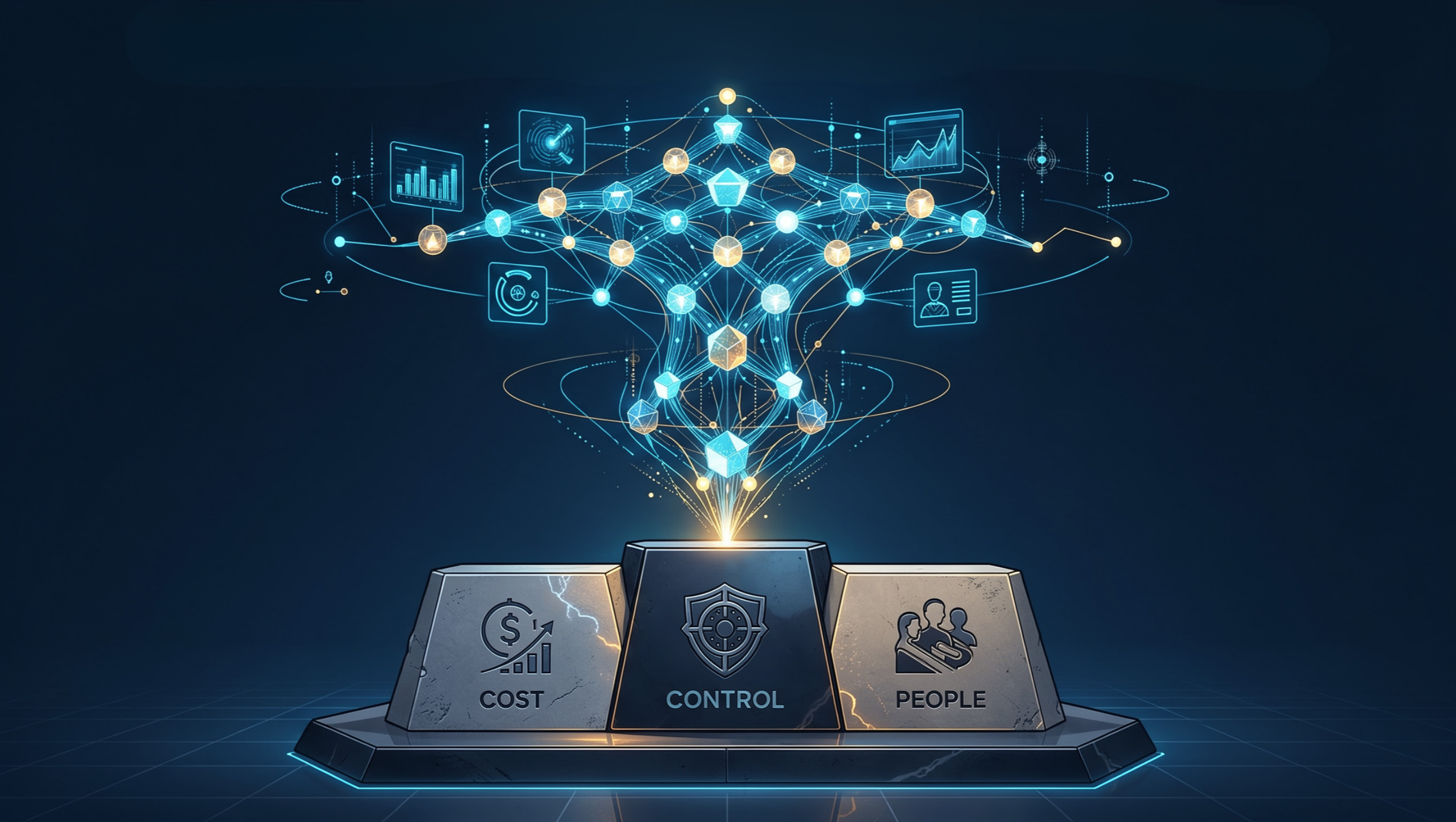
Three themes came up repeatedly: governance, ROI and people.

The Real Test Comes After the AI Pilot
Running an AI pilot and putting AI into production are two very different things.
Pilots tend to involve a limited number of users, making them relatively inexpensive. Scaling is where costs can increase, and the sessions highlighted the importance of controlling those costs early. Token usage overruns, for example, can happen within days.
There is a people difference too. Pilots are typically driven by motivated individuals who actively want to experiment with the technology. A production rollout brings in a much broader group of users, who may have less incentive to change how they work.
That distinction matters. Businesses shouldn’t assume that what worked during a pilot will automatically translate into the same results when rolled out more widely.
There is also a question around whether to build or buy. As AI moves into production, scaling an internally developed approach can become expensive, making vendor solutions worth considering alongside the cost of building and operating a solution internally.
Before moving into production, teams need to ask:
- What will the solution cost when hundreds or thousands of people use it?
- Who is accountable for its performance and outcomes?
- What systems and data will it access?
- How will quality, security and compliance be monitored?
- What support will users need?
- What happens when the AI produces an incorrect or inappropriate result?
Answering these questions early makes it easier to build a realistic business case and avoid expensive surprises later.
AI ROI is Bigger Than Cost Savings
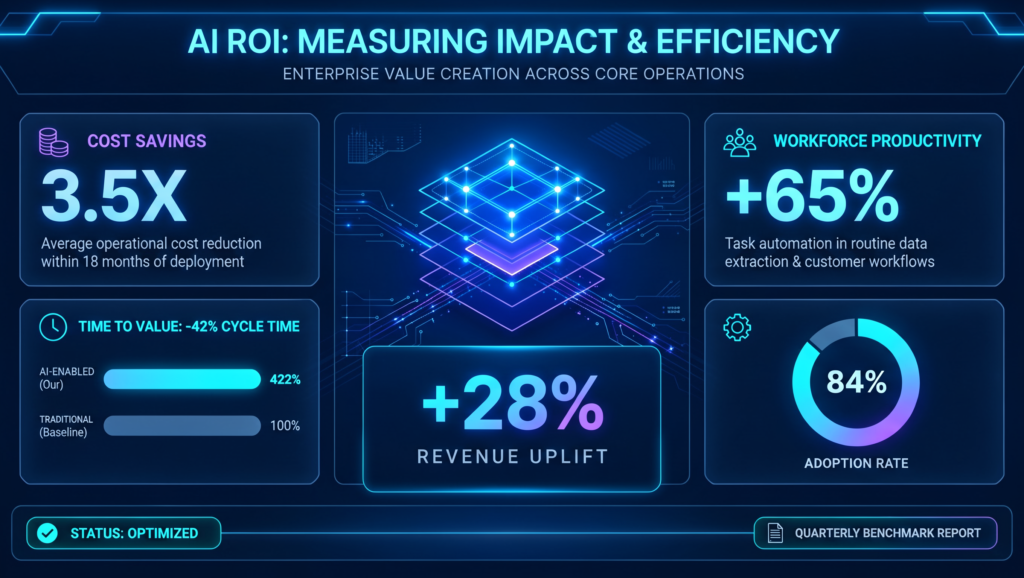
The pressure to prove a return on AI investment is growing. But not every benefit appears immediately in revenue or cost savings.
A useful way to approach AI value is through four lenses:
- Increasing revenue, such as improving conversion, accelerating sales or creating new services.
- Reducing costs, through automation, faster processes or more efficient use of resources.
- Reducing risk exposure, by improving consistency, monitoring or decision support.
- Improving quality of work, by removing repetitive tasks and helping employees focus on higher-value activities.
The first two are usually easier to express in financial terms. The others may take longer to measure, but they still affect performance. Better employee experiences can support retention, productivity and service quality. Stronger controls can reduce the likelihood of incidents whose financial impact may only become visible when something goes wrong.
The key is to agree on the intended value before selecting the technology.
If the goal is to help customer-service teams resolve cases faster, the programme should track resolution time, escalation rates and customer outcomes. If the goal is to support engineers, it might measure development time alongside defects, security issues and future maintenance effort.
A simple productivity claim such as “the tool saves each employee ten minutes a day” is not enough on its own. The business must also understand whether that time is being converted into something useful.
Govern AI Like a Business Capability
AI may be developing quickly, but that doesn’t mean businesses need to abandon the governance principles they already know.
Role-based access control, application-layer security and retention policies were all highlighted as practical approaches to AI governance.
AI agents add another dimension. The recommendation was to think about them much like employees: give them a defined role and put clear limits and time controls around what they can do.
A useful approach is to treat each agent like a digital employee. Every agent should have:
- A clearly defined role
- A named business owner
- Limits on the systems and information it can access
- Rules governing which actions it may take
- Spending or usage controls
- Escalation points for human review
- A clear process for monitoring, suspension and retirement
This matters in every region. While legal requirements differ between markets, the operational risk is universal. An agent operating with excessive permissions or unreliable information can create financial, security and reputational consequences wherever the organisation is based.
Don’t Try to Make Everything AI-Ready at Once
Another important question is how much work businesses should do on their data before adopting AI.
The takeaway was to favour use-case-driven data preparation rather than launching broad AI-readiness programmes across the entire organisation.
Federated data approaches, such as knowledge catalogues and semantic layers, are becoming more common. But contextualising data at full organisational scale requires significant investment.
Starting with a defined use case changes the equation.
Instead of trying to prepare everything, businesses can concentrate investment on the data required to deliver a specific outcome. That creates a more focused route into AI adoption while avoiding the assumption that the entire data estate must be transformed first.
For global organisations in particular, this approach can also support clearer decision-making about where investment is actually needed, rather than treating AI readiness as one single, organisation-wide exercise.
The Hardest Part of Transformation is Still People
Technology is only part of the equation.
The discussions around transformation repeatedly returned to accountability, ownership and the importance of keeping momentum going.
Leadership matters, but top-down direction alone isn’t enough. Middle management needs to be included if change is going to translate into day-to-day behaviour. And rather than relying only on KPIs, businesses need to think about whether people are actually changing how they work.
One suggestion was to look at channel-choice metrics to understand behavioural change, rather than relying solely on measures such as NPS. What people actually choose to use can tell businesses more about adoption barriers than satisfaction scores alone.
Messaging matters too.
For leadership, the focus may be bottom-line impact and strategic alignment. For employees, the benefits need to be much more visible and relevant to everyday working life.
There is also the risk of transformation fatigue. Sustaining energy through continued change requires attention, rather than assuming enthusiasm will remain constant throughout a programme.
For organisations operating across different countries, teams and business units, that makes clear and localised communication particularly important. The overall direction can remain consistent while the way the benefits are communicated reflects the people affected by the change.
AI-Assisted Engineering: Faster Doesn’t Mean Better by Default
One standout discussion focused specifically on the changing role of engineers as AI becomes more capable of producing code.
The concern wasn’t simply whether AI can code. It was what happens when engineers begin accepting increasingly large volumes of AI-generated output without fully understanding what has been produced.

A simple question captured the issue:
“Can I explain and understand this?”
If an engineer can’t answer yes, there is a problem.
As AI output increases, a lack of understanding can reduce explainability and create future troubleshooting issues. Before accepting AI-generated code, engineers therefore need to ask whether it is production-level, secure and future-proof.
The advice was clear: don’t skip the cognitive ability to reason, and don’t stop investing in engineering fundamentals simply because AI can produce more of the output.
Domain Expertise Becomes the Differentiator
The longer-term discussion around AI and engineering was even more interesting.
As AI becomes increasingly capable of producing production-grade code and moving towards more autonomous code generation, engineering roles themselves could evolve.
The suggested direction was a shift from solution engineer towards solution architect, but with an important condition: engineers still need to master production-level code first.
Rather than making expertise irrelevant, AI could make deep expertise more important.
The combination highlighted at the event was:
Domain expertise + AI capability
Industry-specific knowledge, engineering fundamentals, the ability to reason and the judgement to assess AI output all become part of what differentiates people in an AI-assisted environment.
That creates a useful lesson well beyond engineering. AI can produce more output, but people still need the expertise to decide whether that output is good enough, appropriate and useful.
What Does This Mean for Businesses?
The bigger lesson from all of these conversations is that AI adoption isn’t simply a technology programme.
For businesses moving from experimentation towards larger-scale adoption, five priorities stand out:
- Plan beyond the pilot: A successful pilot doesn’t automatically tell you what production will look like. Think about scaling costs, token usage and user adoption before widening deployment.
- Define what value actually means: Revenue and cost aren’t the only lenses. Risk reduction, productivity and quality of working life can also form part of the business case, but different benefits may emerge over different timeframes.
- Put governance in from the beginning: Use established controls such as RBAC, application-layer security and retention policies, and put defined roles and limits around AI agents.
- Focus data investment around real use cases: Preparing an entire organisation’s data for AI can require significant investment. Start with the data required for a defined business problem before expanding further.
- Don’t let AI replace understanding: Whether you’re deploying AI across the business or using it to generate software, human reasoning, domain expertise and professional judgement remain critical.
The businesses that get the most from AI won’t necessarily be those that run the most pilots or generate the most AI output. The real challenge is turning experimentation into something the organisation can govern, afford, understand and actually use.
That is where AI moves from an interesting technology experiment to meaningful business transformation.
Author: Mason Hiroto, Senior DX Consultant