Big Data LDN 2026 at a Glance
Held at Olympia London on 23–24 September 2026, Big Data LDN brought together a two-day conference and exhibition covering data platforms, architecture, governance, analytics and the practical adoption of enterprise AI. The sessions explored both the technical foundations and the organisational changes needed to turn these capabilities into everyday business value.
Overall Observations from the Event
Four themes stood out across the event.
- Business Value Before Technology. Successful initiatives begin with a clear business problem, an accountable owner and a measurable outcome. Platform selection should follow that understanding, rather than determine the direction of the programme.
- Trusted Data as the Foundation. Reliable information, common definitions and appropriate business context provide the basis for useful enterprise AI. More capable models cannot remove the need to understand the data they consume.
- Adoption Requires Deliberate Design. A new platform does not automatically change how people work. Practical use cases, domain ownership and visible benefits for users help translate technical capability into adoption.
- Governance Enables Self-Service. Wider access to data needs clear ownership and appropriate controls. Shared definitions and ongoing data-quality monitoring help people use information confidently and consistently.
Everyone wants agents. Few are ready for them. And it’s already going wrong
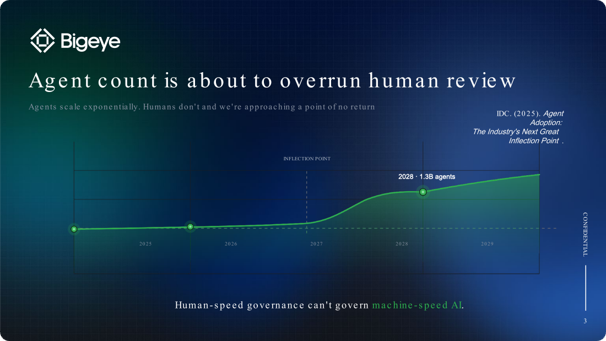
Bigeye’s session illustrated the risks of introducing agents without the foundations to support them. In a scenario presented during the session, a bank’s lending agent helped approve a $40,000 credit-limit increase before the customer defaulted. Stale income data and an unresolved quality issue contributed to the decision, while the bank could not trace the agent’s relationship to its underlying data, access permissions or controls. The example showed how weaknesses beneath an agent can undermine its decisions.
The session also cited Gartner projections suggesting that the number of agents in an average Fortune 500 firm could increase from 15 in 2025 to 150,000 in 2028. A further Gartner prediction, cited by Bigeye, suggested that 60% of organisations would fail to achieve AI value by 2027 because they had not joined up data and AI governance. These were conference-cited forecasts, rather than observed outcomes, but they framed the urgency of establishing accountability before agent deployment expands.
Data & AI Insights from Conference Sessions
Building a Data-Driven Organisation, Not Just a Data Platform
Lauren Bowen, Senior Delivery Director at CI&T, and Neil O’Connor, CTO of Experian Consumer Services UK&I, shared an Experian case study on using a platform upgrade to support broader organisational change, business adoption and internal capability development.
Their central message was that a modern platform creates value when business ownership and practical adoption support it. Embedding technical specialists alongside internal domain teams helps combine external expertise with knowledge of how the business operates. Practical, business-relevant examples also give people a clearer reason to adopt new capabilities than top-down communication alone.
The session encouraged organisations to move data ownership closer to product and business domains, rather than treating it as solely an IT responsibility. Reliable, governed data should precede the introduction of AI-enabled services.

Bigeye’s session illustrated the risks of introducing agents without the foundations to support them. In a scenario presented during the session, a bank’s lending agent helped approve a $40,000 credit-limit increase before the customer defaulted. Stale income data and an unresolved quality issue contributed to the decision, while the bank could not trace the agent’s relationship to its underlying data, access permissions or controls. The example showed how weaknesses beneath an agent can undermine its decisions.
The session also cited Gartner projections suggesting that the number of agents in an average Fortune 500 firm could increase from 15 in 2025 to 150,000 in 2028. A further Gartner prediction, cited by Bigeye, suggested that 60% of organisations would fail to achieve AI value by 2027 because they had not joined up data and AI governance. These were conference-cited forecasts, rather than observed outcomes, but they framed the urgency of establishing accountability before agent deployment expands.
Data & AI Insights from Conference Sessions
Building a Data-Driven Organisation, Not Just a Data Platform
Lauren Bowen, Senior Delivery Director at CI&T, and Neil O’Connor, CTO of Experian Consumer Services UK&I, shared an Experian case study on using a platform upgrade to support broader organisational change, business adoption and internal capability development.
Their central message was that a modern platform creates value when business ownership and practical adoption support it. Embedding technical specialists alongside internal domain teams helps combine external expertise with knowledge of how the business operates. Practical, business-relevant examples also give people a clearer reason to adopt new capabilities than top-down communication alone.
The session encouraged organisations to move data ownership closer to product and business domains, rather than treating it as solely an IT responsibility. Reliable, governed data should precede the introduction of AI-enabled services.
Agentic AI: Visibility and Control
As agents become more widespread, organisations need an inventory that answers six questions:
- What agents exist? Visibility should extend across teams, tools and cloud environments.
- Who owns them? Each agent needs a named, accountable owner.
- What can they access? This includes systems, data stores and APIs.
- What data do they touch? Organisations need to understand the relevant records, fields and classifications.
- What actions can they take? Permissions may allow agents to read, write, transact or trigger other processes.
- What do they cost? Oversight should include compute, token usage and API expenditure.
Control must continue throughout an agent’s lifecycle. Standards, review and approval establish expectations before deployment. During operation, controls should allow an action, require additional checks or deny it. Afterwards, audit and incident review should inform better policy.
Recommended Sequence for AI Adoption
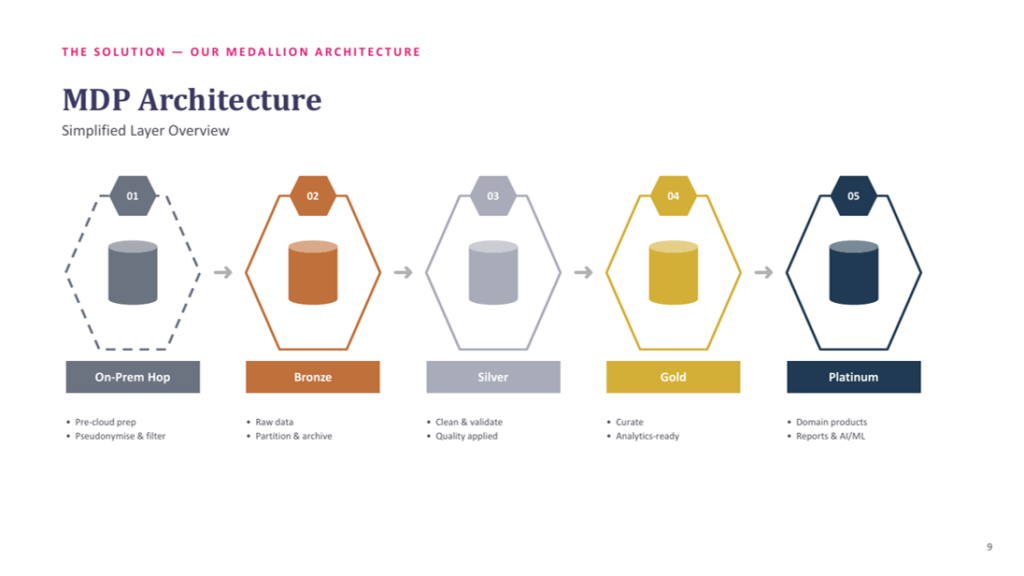
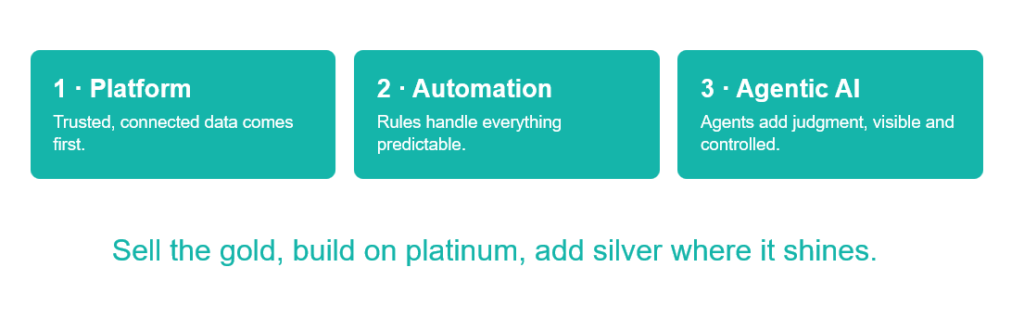
The recommended sequence begins with a platform of trusted, connected data. Workflow automation then handles predictable activities, and agentic AI adds judgement under visible, defined controls. In the metal-layer analogy, the practical emphasis is to build on platinum, demonstrate the value of gold and introduce silver where it contributes something useful.
Context Engineering: Making Enterprise AI Useful
Models are getting smarter faster than they get useful
Imagine welcoming a new colleague who knows plenty about the world but nothing about your organisation. They can solve difficult problems, yet they still need someone to explain which figures the team trusts, who approves a decision and what a customer is allowed to see.
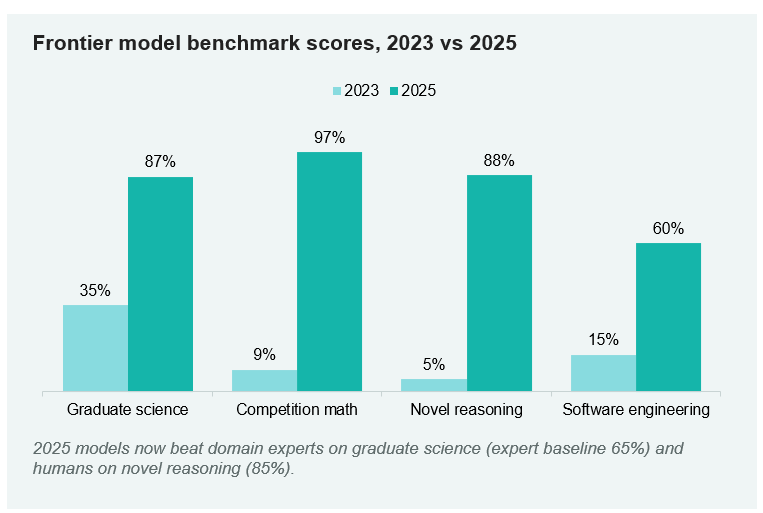
The context-engineering discussion explored the gap between model capability and business value. A comparison of frontier-model benchmarks from 2023 to 2025 described models surpassing an expert baseline of 65% on graduate-level science and a human baseline of 85% on novel reasoning. Alongside those capability gains, the session material cited figures suggesting that 56% of CEOs had seen no financial benefit from AI and that only one in five organisations reported significant value, with the latter attributed to Gartner.
The underlying issue, however, was clear: better benchmark performance does not automatically translate into useful outcomes within a business.
Performance = Intelligence + Context
The equation “Performance = Intelligence + Context” offered a way to explain that gap. Model providers such as OpenAI, Anthropic and Google develop the intelligence layer, which competitors can also access. Each organisation must supply the business context that makes those capabilities relevant to its own work. Much of that understanding sits across fragmented applications, conversations and people’s experience.
A human-performance analogy illustrated the point through an approximate 10% contribution from cognitive ability and 90% from other factors, including learning on the job, feedback, adaptability and relationships. The presentation attributed the analogy to Sternberg and Wagner (1986) and Sackett, Zedeck and Lievens (2017). These proportions serve as an illustration of the importance of context, not a measured formula for AI performance.
The idea behind “Performance = Intelligence + Context” is simple: useful AI needs both capability and familiarity with the job.
Context grows through experience
The Atlan framework breaks business context into three everyday questions:
- What do we need to know? The language of the business, what its figures mean and how things connect such as business entities, definitions, metrics and relationships.
- How do we get things done? The methods experienced colleagues use to investigate problems and complete tasks (playbooks, workflows and diagnostic procedures).
- What are the boundaries? Who can see which information, what needs approval and when to involve someone else.
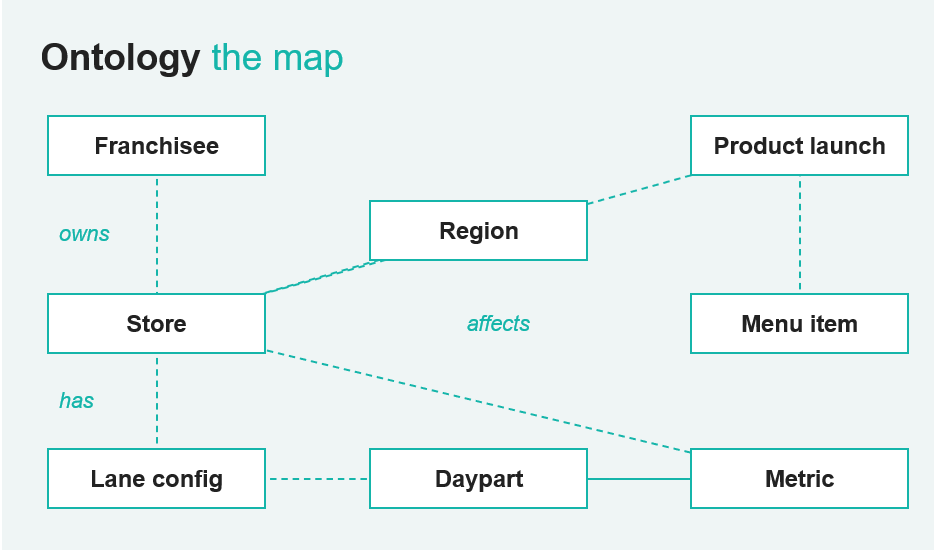
Consider a new analyst working with restaurant data. At first, she learns the terminology and where to find the numbers. Later, she discovers that sending a colleague the figures does not answer their real question: why did this happen? Another correction teaches her that a franchise owner should receive information about their own stores, rather than the entire chain.
Each experience makes her better at the job. AI needs a similar learning loop, with corrections captured and shared so that the same misunderstanding does not keep returning.
Making everyday business knowledge usable
Turning this knowledge into something AI can use sounds technical, but the practical questions are familiar.
- Ontology: the map. What connects to what?: AI needs a clear picture of the business. In a restaurant chain, that includes which stores belong to which franchisee and how products, locations and trading periods relate to one another. This helps it understand what someone means when they ask a question.
- What exactly does this number mean?: A measure such as “drive-through time” needs an agreed definition. When does the clock start and stop? Which records should count? Who owns the definition? Giving AI those answers helps it use the right calculation rather than choose a plausible one.
- Which information can it use?: Clear definitions need to connect to the right records and access permissions. AI must understand both where to find information and whether it can use that information for the task at hand.
- How should it approach the task?: Experienced colleagues often follow a familiar sequence when investigating a problem. Capturing those steps gives AI a useful guide, including what to check and how to assess a possible remedy.
Why it matters, and what to do about it
Business context can become a durable organisational advantage as model capabilities become more widely available. Shared definitions and accumulated experience form part of an organisation’s intellectual property. The discussion also drew on Conway’s Law: systems reflect how organisations communicate, so fragmented understanding can limit the coherence of AI. A related lesson from business intelligence is that improving the movement of data does not necessarily improve understanding of it.
For enterprise AI programmes, this suggests four practical actions:
- Begin with one domain. Capture its knowledge, expertise and norms before expanding the agent population.
- Establish ownership early. Assign context owners and an approval path while the programme is still small, by agent four rather than agent thirty.
- Keep context portable. A vendor-neutral context layer helps protect organisational knowledge from dependence on a single platform.
- Capture corrections from day one. Feedback and traces of mistakes provide material for improving the context available to future users and agents.
Conclusion
Big Data London 2026 made one message clear: enterprise AI delivers value only when strong foundations are in place. Organisations should start by selecting one high-value business problem, assigning accountable owners and ensuring the necessary data, context and controls are ready. From there, they can test the approach, measure its impact and scale what works. The next step is not to deploy more AI, but to build the trusted foundation that makes every deployment useful, safe and sustainable.
Authors:
Swarup Kar, AI Consultant
Yuna Kim, DX Consultant
Sneha Datti, DX Consultant