What happens when customers stop searching and start asking? What happens when an AI assistant compares the market before your website ever loads? And what happens when the customer can buy the product without visiting your site at all?
For the past two decades, e-commerce has been built around a familiar pattern: search, browse, compare, click, add to basket, checkout.
That model is now being challenged.
The rise of LLMs (large language models), AI search, shopping assistants and agentic checkout is beginning to reshape how customers discover, evaluate and buy products online. This does not mean e-commerce websites are about to disappear. But it does mean their role is changing : from being the primary destination for discovery to becoming part of a wider AI-mediated commerce ecosystem.
The question for retailers and B2B commerce organisations is no longer simply: “How do we get more traffic to our website?”
It is becoming: “How do we make our products discoverable, trusted and purchasable through AI?”
AI is Already Entering the Shopping Journey
The early data suggests this shift is already underway. Statista reported that around one in five Americans had used AI platforms to search for products while shopping, showing that AI-assisted product discovery is no longer a fringe behaviour.
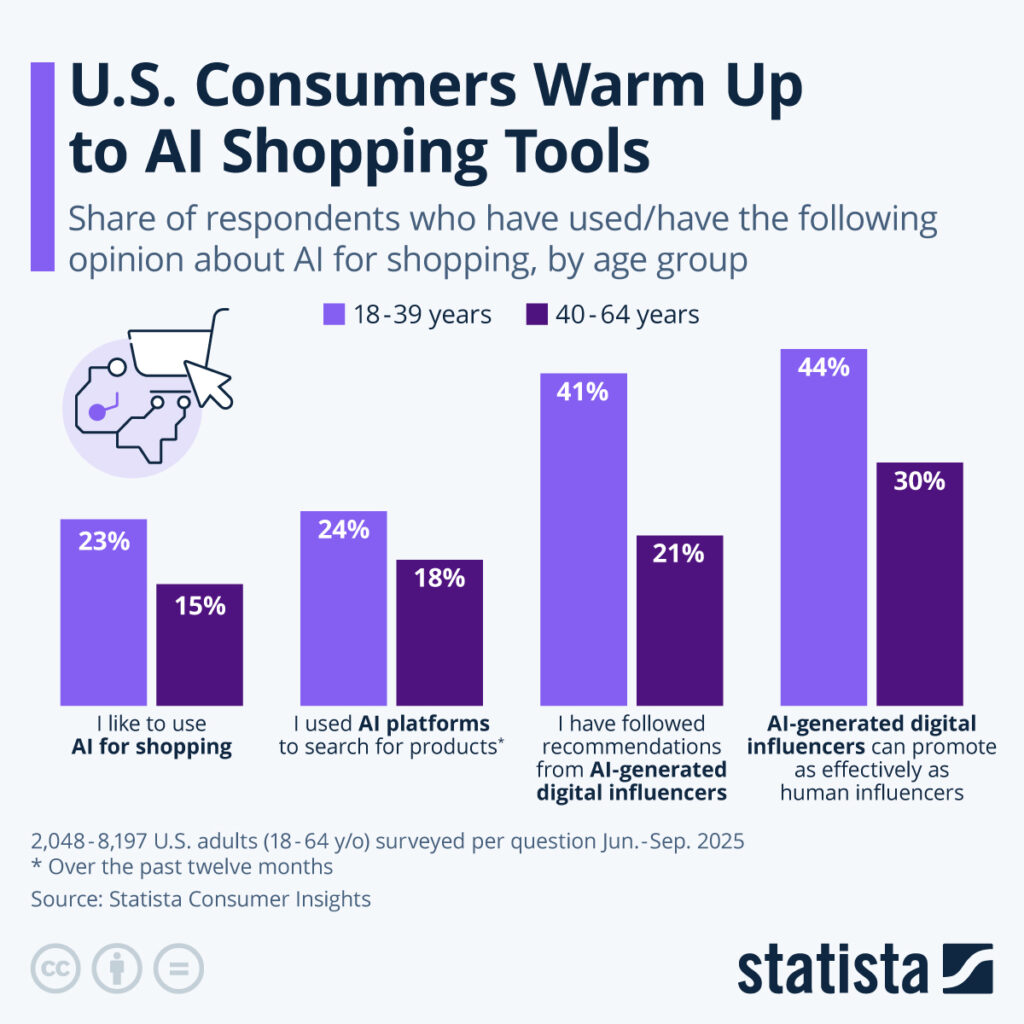
The most common use cases included product research, recommendations, finding deals, gift ideas, unique products and shopping lists. These are not peripheral activities. They sit at the centre of the buying funnel: awareness, consideration, comparison, decision and conversion. In other words, AI is not just helping customers shop. It is beginning to influence what customers choose.
The customer journey is being compressed
Traditional e-commerce journeys are fragmented. A customer may start with Google, open several retailer tabs, check reviews, compare marketplaces, watch a video, ask a friend, return to search and eventually buy.
LLMs compress that journey.
Instead of typing fragmented search terms such as “best business laptop under £1,000”, a customer can ask: “Find me the best lightweight laptop for travel, Teams calls and PowerPoint work under £1,000.”
That single prompt contains intent, context, budget, usage, constraints and decision criteria. It gives the AI assistant far more information than a traditional keyword search. This is a fundamental behavioural shift. Product discovery is moving from keyword matching to intent interpretation.
Google’s AI shopping experience is a useful signal of where this is going. Its AI Mode is powered by Google’s Shopping Graph, which includes more than 50 billion product listings, with 2 billion updated every hour.
That scale matters. AI shopping is not just a chatbot interface layered over existing e-commerce. It is becoming a new decision layer between the customer and the retailer.
AI is becoming a new acquisition channel
Retailers should pay close attention to AI referral traffic. Adobe reported that traffic to U.S. retail websites from generative AI sources increased by 1,200% between July 2024 and February 2025.
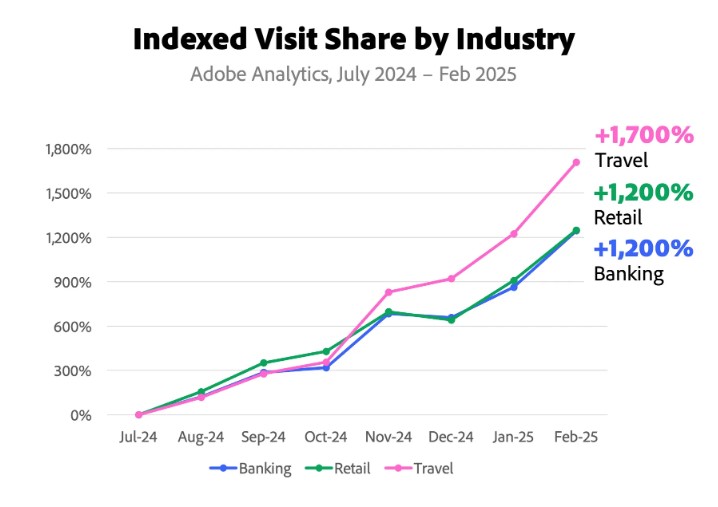
The implication is significant. AI-generated traffic may still be lower than traditional search today, but it is likely to be higher intent. If a customer arrives at a retailer’s website after an AI assistant has already helped them define their need, compare options and narrow the shortlist, that visit may be much closer to conversion.
This changes how e-commerce performance should be measured. In an AI-mediated journey, website visits alone may become a weaker indicator of influence. Retailers will need to understand whether they are visible in AI-generated recommendations, whether their product data is being interpreted correctly, and whether their content is trusted enough to be included in the shortlist.
In the same way that retailers once had to learn search engine optimisation, they may now need to learn AI visibility optimisation.
Direct buying through AI is no longer theoretical
The next shift is not just AI-assisted discovery. It is AI-enabled transaction.
OpenAI launched Instant Checkout in ChatGPT in September 2025, allowing U.S. users to buy directly from U.S. Etsy sellers in chat, with Shopify merchants planned. Stripe also confirmed that it is powering the experience through its Agentic Commerce Protocol, developed with OpenAI.
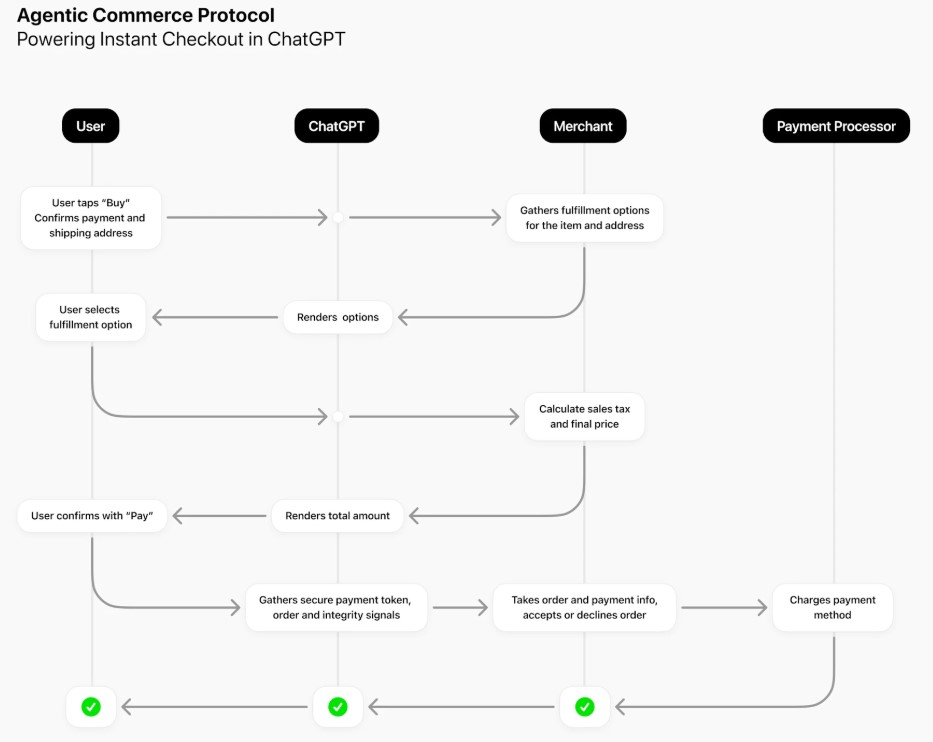
This is a major strategic signal. ChatGPT is no longer only a place to ask what to buy. It is becoming a place where purchases can happen.
For retailers, this raises an uncomfortable question: If customers can discover, compare and buy through an AI assistant, what is the role of the e-commerce website?
The answer is not that websites become irrelevant. It is that websites become both experience and infrastructure.
Five forces are converging
This shift is being driven by several factors at once.
1- Conversational discovery: Customers increasingly want recommendations framed around their specific needs, not generic product listings.
2- AI-readable product data: Product descriptions, specifications, availability, pricing, delivery options, reviews and returns policies need to be structured, accurate and accessible to AI systems.
3- Embedded checkout: As platforms such as ChatGPT and Google move closer to the transaction, checkout may increasingly happen outside the retailer’s own website.
4- Personalisation at scale: AI assistants can interpret individual preferences, budgets, constraints and previous interactions to create more tailored buying journeys.
5- Trust and validation: As AI becomes the intermediary, retailers need stronger proof points: reliable reviews, transparent pricing, clear returns policies, accurate stock data and credible brand content.
Together, these forces point to a new model of digital commerce: AI-mediated buying.
The future role of the e-commerce website
The e-commerce website will still matter. But its strategic role will evolve.
It will become the source of truth for product and brand data.
It will provide the trust layer customers need before purchase.
It will support checkout, fulfilment, returns and aftercare
It will act as a brand experience layer in a world where discovery may happen elsewhere.
And it will become a critical part of the retailer’s AI commerce architecture.
In the past, retailers optimised primarily for human navigation: menus, filters, landing pages, product detail pages and checkout journeys.
In the next phase, they will also need to optimise for machine interpretation: structured product feeds, metadata, schema, comparison content, FAQs, review quality, product availability and integration with AI shopping ecosystems.
The website becomes less of a standalone digital shopfront and more of a commerce operating layer.
What commerce leaders should do now
For e-commerce leaders, the priority is not to abandon existing platforms. It is to make them AI-ready. That means asking four questions:
Can AI assistants understand our products accurately?: If product data is incomplete, inconsistent or poorly structured, AI systems may overlook or misrepresent the offer.
Can customers trust what AI surfaces about us?: Trust signals such as reviews, warranty information, delivery confidence and returns policies become even more important.
Can our commerce platform support transactions beyond our own website? Retailers may need to support distributed checkout across AI assistants, marketplaces, social channels and partner ecosystems.
Can we measure influence when the journey starts outside owned channels? Marketing attribution, SEO, conversion analytics and customer journey measurement will need to evolve.
This is where digital transformation becomes commercially critical. AI-commerce readiness is not only a marketing issue. It cuts across data, architecture, customer experience, integration, governance and operating model.
Final Thoughts
The next phase of e-commerce will not be defined by websites versus AI. It will be defined by how well retailers connect the two.
Customers will still visit websites. But increasingly, they may arrive after an AI assistant has shaped the shortlist, compared the options and influenced the decision.
For retailers, the strategic challenge is clear:
Do not just optimise for where customers clicked yesterday. Optimise for where AI will recommend, compare and transact tomorrow.
Author: Dave Crossley, Senior DX Consultant