Manufacturing is being rewritten. The efficiency-first model of Industry 4.0 is not being torn up, it is being pointed at a bigger target. The European Commission has been explicit that Industry 5.0 complements Industry 4.0 by orienting the same technologies toward three new pillars: human-centricity, sustainability, and resilience.1 This article sets out what the shift means for industrial leaders, what evidence supports it, and how organisations are putting it into practice.
From Steam Engines to Smart Factories: The Road to Industry 5.0
Industry 4.0 emphasised smart, interconnected factories built on cyber-physical systems and the Internet of Things.1 Industry 5.0 acknowledges that efficiency and productivity, while necessary for competitiveness, are not by themselves enough to address climate change, social inequality and supply chain volatility.1 The point is not to reject Industry 4.0 technologies. The point is to orient them toward societal well-being and planetary health.10
The shift to Industry 5.0 sits in a longer arc of technological change in production. The First Industrial Revolution, roughly 1760 to 1840, moved manufacturing from manual labour and animal power to machine-based processes.5 The commercial steam engine, invented by James Watt in 1778, was the catalyst,5 and the modern factory system emerged.
The Second Industrial Revolution, from 1870 to 1914, made electricity the dominant energy source and gave rise to mass production.13 Standardised assembly lines, pioneered by Henry Ford in 1913,16 created the competitive advantage of economies of scale and affordable standardised goods.16

The Third Industrial Revolution, beginning in the 1970s, was the digital revolution. Programmable logic controllers and early computer systems allowed partial automation of production lines and reduced human intervention in repetitive and hazardous tasks.5,14 Industry 3.0 laid the groundwork for the internet-driven transformation that followed.14
The Fourth Industrial Revolution, or Industry 4.0, emerged around 2011 as a strategic initiative to build smart factories through cyber-physical systems and the Internet of Things.1 The goal was a continuous flow of real-time data across the value chain, enabling predictive maintenance, self-organised logistics, and autonomous production systems.5 As implementation matured, two limits became visible. Productivity gains often came at the cost of human intuition and creativity in the workplace, and the increased energy demand of large-scale digitalisation raised environmental concerns.1
Why Industry 5.0 is Emerging Now
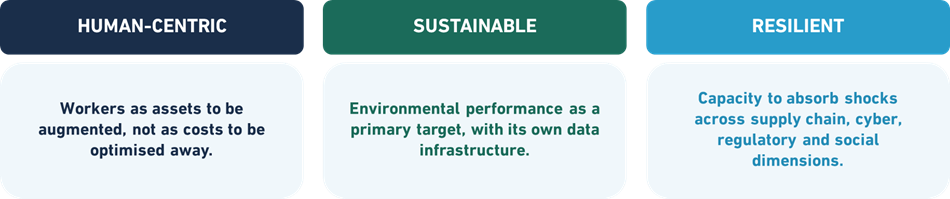
Industry 4.0 prioritised efficiency and competitiveness. Industry 5.0 keeps those goals and adds three more: human-centricity, sustainability, and resilience.1 The shift was articulated by the European Commission in its 2021 report, “Industry 5.0: Towards a Sustainable, Human-centric and Resilient European Industry,” which argued that industry must contribute to society by placing workers at the heart of the production process.1
Two external pressures pushed the agenda forward. The COVID-19 pandemic exposed the fragility of lean, just-in-time supply chains. The escalating climate crisis exposed the need for regenerative production models.1
Pillar One: Human-Machine Collaboration
The first pillar puts the human element back at the centre of manufacturing.4 The shift is from mass customisation, where the goal was variety at scale, to mass personalisation, where machine precision is combined with human creativity and judgement.4
How Collaborative Robots (Cobots) Enhance Human Performance
In an Industry 5.0 factory, collaborative robots, or cobots, work alongside humans rather than replacing them. Cobots handle repetitive, precise, or physically demanding tasks while humans focus on quality control, supervision, and complex problem-solving. The relationship is synergistic: robots provide precision and endurance, humans bring intuition, adaptability and contextual judgement. Research from Travellers Insurance indicates that cobots can reduce workplace injuries by taking on hazardous or ergonomically harmful tasks, while improving throughput on lines that benefit from sustained precision.29 The mechanism that makes cobots valuable is not faster robots. It is operators with better tools and safer working conditions, doing higher-judgement work.
Human-Centricity as a Strategic Asset
Industry 5.0 views workers as assets to be augmented, not as a cost to be optimised away. Augmented reality and wearable devices empower operators with live data on machine status, process steps, and safety alerts. The intent is to make experienced operators more effective and to reduce the time it takes new operators to reach proficiency.
The “human factor” extends beyond technology. It includes worker well-being, psychological safety, and meaningful career paths. Generation Z, entering the workforce now, expects manufacturing roles that are technology-rich and human-centric.34,35,36 Organisations that ignore this expectation will lose talent to organisations that do not.
Industry 5.0 views workers as assets to be augmented, not as a cost to be optimised away.
Pillar Two: Making Sustainability a Core Business Objective
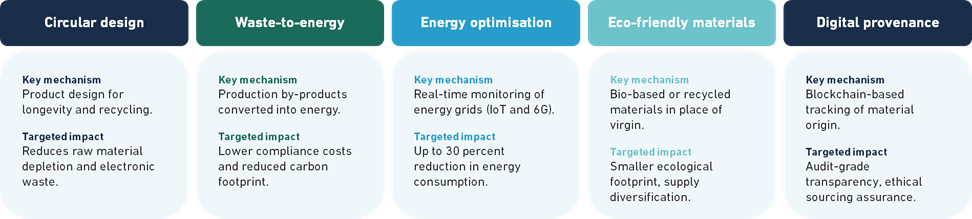
Industry 5.0 establishes sustainability as a cornerstone of industrial strategy, not a downstream by-product. Where Industry 4.0 treated environmental gains as an efficiency dividend, Industry 5.0 treats them as a primary strategic objective.2 The shift moves the operating model from “take-make-waste” to circular flows of materials, energy and information.
From Linear Production to Circular Value Creation
The circular economy in Industry 5.0 covers the entire product lifecycle, from design through disposal. Manufacturers are adopting closed-loop supply chains, sustainable sourcing, and digital twins that simulate product lifecycles to optimise resource use and reduce waste.3
Strategic Environmental Benchmarks: Turning Sustainability into a Measurable KPI
International standards anchor day-to-day operations. ISO 14001 is widely used to monitor environmental performance, and certifications such as the International Sustainability and Carbon Certification (ISCC+) provide traceability in circular supply chains.3 In Europe, the Energy Efficiency Directive recast of 2023 binds an 11.7 percent reduction in final energy consumption by 2030 against the 2020 reference, with mandatory energy management systems for enterprises above 85 terajoules per year. The Corporate Sustainability Reporting Directive requires large EU-active manufacturers to report against the European Sustainability Reporting Standards. These rules turn environmental performance into an auditable operational metric rather than a marketing statement.
Pillar Three: Building Resilient Operations for an Uncertain World
The third pillar is resilience: the capacity of industrial systems to absorb shocks and continue operating. Industry 4.0 narrowed reliability to safety and cybersecurity, treated as engineering problems. Industry 5.0 treats resilience as a system property that covers supply chain, cyber, regulatory, and social shocks.
Flexible and agile production
Resilience is achieved partly through flexible production. The “factory in a box” concept, modular self-contained manufacturing units that can be deployed quickly close to demand, is one emerging answer for localised production.28 Additive manufacturing, including 3D printing, lets operators produce spare parts and small batches on-site, reducing dependence on long, single-source supply chains.70,71
Predictive intelligence and supply chain visibility
Resilience also depends on advanced data analytics and real-time visibility. Manufacturers using IoT-enabled tracking, such as radio-frequency identification, instead of manual cycle counts report 10 to 14-day warning windows on supply anomalies, allowing for proactive intervention before disruption hits production. The McKinsey Global Institute baseline that companies face supply chain disruptions of a month or more roughly every 3.7 years has held up through the post-pandemic period. Resilience requires explicit investment in capacity buffer, dual sourcing, network segmentation, operational-technology detection, and incident response. It does not emerge from optimising for unit cost.
The Technologies Powering Industry 5.0
6G networks Terabit-per-second bandwidth and sub-millisecond latency let millions of sensors, robots and machines be tracked and optimised at once, while network-level AI routes data efficiently for sustainability gains. Haptic remote telepresence lets experts run distant machines — designed to extend human reach, not displace site operators.43,44
Explainable AI (XAI) As AI takes on predictive maintenance and quality control, XAI traces why a model produced an output, such as which sensor readings triggered a shutdown. Training-data attribution, influence scoring and audit trails support EU AI Act compliance and build the trust human-machine collaboration depends on.48,49
Digital twins and information fusion Virtual replicas enable real-time monitoring and optimisation. Powered by information fusion — IoT sensors, PLCs, third-party databases and human inputs — they form a live mirror of the factory that flags failure before unplanned downtime.13,27
Market Landscape and Growth Projections
The Industry 5.0 market is growing rapidly. Published estimates put the global market size between approximately USD 87 to 103 billion in 2025 and over USD 1 trillion by 2034, at a CAGR of around 30 percent.31 Although North America will continue to be the largest region, Asia-Pacific will grow the fastest. AI and cloud spending will dominate the technology spend.27,53,54 Adoption is restrained by high implementation complexity and the need for significant infrastructure upgrades.54
A Practical Roadmap to Industry 5.0 Adoption
The transition to Industry 5.0 is not a single rollout. It is a phased journey that requires strategic foresight and cultural agility.37 Five phases capture the practical sequence.

The Future of Manufacturing Is Human-Centric
Industry 5.0 represents a reorientation of manufacturing, not a replacement of Industry 4.0. The same technologies are being put to a different set of objectives: people, planet, and resilience, alongside productivity and efficiency.10 The most advanced smart factory is one that empowers human workers, operates within ecological limits, and adapts quickly to a changing world.3
For industrial leaders, the question is no longer whether to engage with Industry 5.0 but how. Building resilient, adaptive, and human-centric operations is the next business imperative. It rewards those who can combine advanced technology with enduring human values.69
Works cited
- What Are Industry 4.0 and Industry 5.0 All About? An Integrative …, accessed on May 13, 2026,
https://www.mdpi.com/2076-3387/15/4/118 - Comparison of Industry 4.0, Industry 5.0, and Related Political Initiatives Using Bibliometric Data, accessed on May 13, 2026,
https://www.jiem.org/index.php/jiem/article/download/8587/1127 - INDUSTRY 5.0: THE HUMAN-CENTRIC INDUSTRIAL …, accessed on May 13, 2026,
https://isoqarindia.com/industry-5-0-the-human-centric-industrial-revolution/ - Industry 5.0 Technology: Humans and Machines Synergy – Proaction International, accessed on May 13, 2026,
https://blog.proactioninternational.com/en/industry-50-technology-human-machine-synergy - Short history of manufacturing: from Industry 1.0 to Industry 4.0 – KFactory, accessed on May 13, 2026,
https://kfactory.eu/the-industrial-revolution-short-history-of-manufacturing/ - Nine challenges of Industry 4.0 – IIoT World, accessed on May 13, 2026,
https://www.iiot-world.com/industrial-iot/connected-industry/nine-challenges-of-industry-4-0/ - A systematic review of Industry 5.0 from main aspects to the execution status | The TQM Journal | Emerald Publishing, accessed on May 13, 2026,
https://www.emerald.com/tqm/article/36/6/1526/1223629/A-systematic-review-of-Industry-5-0-from-main - Full article: Behind the definition of Industry 5.0: a systematic review of technologies, principles, components, and values, accessed on May 13, 2026,
https://www.tandfonline.com/doi/full/10.1080/21681015.2023.2216701 - Key components of the business model in an Industry 5.0 environment – Scientific Papers of Silesian University of Technology, accessed on May 13, 2026,
https://managementpapers.polsl.pl/wp-content/uploads/2022/10/158-Grabowska.pdf - Enabling Technologies for Industry 5.0, accessed on May 13, 2026,
https://www.4bt.us/wp-content/uploads/2021/04/INDUSTRY-5.0.pdf - What Is Industry 5.0? Definition, Pillars, and Manufacturing Examples | Intelycx, accessed on May 13, 2026,
https://www.intelycx.com/resources/industry-5-0/ - Industry 5.0 and Human-Centric Manufacturing: A New Blueprint for the Modern Factory, accessed on May 13, 2026,
https://www.parsec-corp.com/blog/industry-5-0-and-human-centric-manufacturing-a-new-blueprint-for-the-modern-factory - A Brief History of The 4 Industrial Revolutions that Shaped the World, accessed on May 13, 2026,
https://ied.eu/project-updates/the-4-industrial-revolutions/ - The Evolution of Industry 1.0 to 4.0 and Beyond – Tech-Labs, accessed on May 13, 2026,
https://tech-labs.com/blog/evolution-industry-10-40-and-beyond - Industry 5.0 Explained: From Human-Machine Rivalry to Partnership | Simio, accessed on May 13, 2026,
https://www.simio.com/blog/industry-5-0-explained-from-human-machine-rivalry-to-partnership - Steam to Silicon: Redefining Manufacturing with Industry 5.0 – Acorn …, accessed on May 13, 2026,
https://www.acornic.co.uk/steam-silicon-manufacturing-industry50/ - Revisited: The Evolution of the Industrial Ages: Industry 1.0 to 4.0 | Simio, accessed on May 13, 2026,
https://www.simio.com/blog/revisited-evolution-industrial-ages-industry-1-0-4-0 - From the First Industrial Revolution to Industry 4.0, accessed on May 13, 2026,
https://www.desouttertools.com/en-us/articles/industrial-revolution-from-industry-1-0-to-industry-4-0 - Advantages and Disadvantages of Industry 4.0 – EDUCBA, accessed on May 13, 2026,
https://www.educba.com/advantages-and-disadvantages-of-industry-4-0/ - Full article: Adaptive social manufacturing: a human-centric, resilient, and sustainable framework for advancing Industry 5.0 – Taylor & Francis, accessed on May 13, 2026,
https://www.tandfonline.com/doi/full/10.1080/00207543.2025.2559137 - Industry 5.0: Shaping the Future of Manufacturing – L2L, accessed on May 13, 2026,
https://www.l2l.com/blog/industry-50-shaping-future-manufacturing - Exploring the Future of Manufacturing: An Analysis of Industry 5.0’s Priorities and Perspectives – MDPI, accessed on May 13, 2026,
https://www.mdpi.com/2071-1050/17/17/7842 - Industry 5.0 or industry 4.0S? Introduction to industry 4.0 and a peek …, accessed on May 13, 2026,
https://pmc.ncbi.nlm.nih.gov/articles/PMC9899508/ - Industry 5.0: Benchmarking national development strategies – global practices and future trends, accessed on May 13, 2026,
https://i5-institute.com/industry-5-0-benchmarking-national-development-strategies-global-practices-and-future-trends/ - From Smart Factories to Human-Centric Factories: The Rise of Industry 5.0 | by Vidhanjain | Apr, 2026 | Medium, accessed on May 13, 2026,
https://medium.com/@vidhanjain277/from-smart-factories-to-human-centric-factories-the-rise-of-industry-5-0-f22f078047d7 - Industry 5.0 – Its Role Toward Human Society: Obstacles, Opportunities, and Providing Human-Centered Solutions | Fostering Sustainable Businesses in Emerging Economies | Emerald Publishing, accessed on May 13, 2026,
https://www.emerald.com/books/edited-volume/14603/chapter/85636864/Industry-5-0-Its-Role-Toward-Human-Society - Industry 5.0 Market Size & Share | Industry Report, 2030 – Grand View Research, accessed on May 13, 2026,
https://www.grandviewresearch.com/industry-analysis/industry-5-market-report - How is AI being used in Manufacturing – IBM, accessed on May 13, 2026,
https://www.ibm.com/think/topics/ai-in-manufacturing - Collaborative Robots as an Engineering Tool for the Transition of the Food Industry to Industry 5.0 – MDPI, accessed on May 13, 2026,
https://www.mdpi.com/2673-4591/100/1/57 - AI Use Cases in Manufacturing: How Artificial Intelligence is Reshaping the Factory Floor, accessed on May 13, 2026,
https://svitla.com/blog/ai-use-cases-in-manufacturing/ - Industry 5.0 Market Size, Share, & Insights Report, 2035, accessed on May 13, 2026,
https://www.rootsanalysis.com/industry-5-market - Industry 5 and the Human in Human-Centric Manufacturing – PMC, accessed on May 13, 2026,
https://pmc.ncbi.nlm.nih.gov/articles/PMC10386219/ - AI Trustworthiness in Manufacturing: Challenges, Toolkits, and the …, accessed on May 13, 2026,
https://www.mdpi.com/1424-8220/25/14/4357 - Gen z and technology: are they the key to handling the transition to industry 4.0?, accessed on May 13, 2026,
https://www.randstadusa.com/business/business-insights/workforce-management/gen-z-technology-are-they-key-to-handling/ - U.S. Manufacturing Success Requires Gen-Z’s Buy-In – Forbes, accessed on May 13, 2026,
https://www.forbes.com/councils/forbestechcouncil/2026/04/17/us-manufacturing-success-requires-gen-zs-buy-in/ - 5 Ways AI Is Attracting Young Manufacturing Talent to Process Industries | Imubit, accessed on May 13, 2026,
https://imubit.com/articles/attract-manufacturing-talent - Roadmap to Implement Industry 5.0 and the Impact of This Approach on TQM | Request PDF, accessed on May 13, 2026,
https://www.researchgate.net/publication/366757433_Roadmap_to_Implement_Industry_50_and_the_Impact_of_This_Approach_on_TQM - Industry 5.0 Manufacturing Roadmap for Smart Factories – bevywise, accessed on May 13, 2026,
https://www.bevywise.com/blog/roadmap-to-industry-5-0/ - Industry 5.0 Market Size, Share & Forecast Report – 2032, accessed on May 13, 2026,
https://www.gminsights.com/industry-analysis/industry-5-0-market - (PDF) The Evolution of Smart Factories: How Industry 5.0 is Revolutionizing Manufacturing – ResearchGate, accessed on May 13, 2026,
https://www.researchgate.net/publication/374921635_The_Evolution_of_Smart_Factories_How_Industry_50_is_Revolutionizing_Manufacturing - XAI for Industry 5.0 – Concepts, Opportunities, Challenges and Future Directions – IEEE Xplore, accessed on May 13, 2026,
https://ieeexplore.ieee.org/iel8/8782661/8901158/10705112.pdf - Industry 5.0 Market Report 2024-2029 [228 Pages & 158 Tables] – MarketsandMarkets, accessed on May 13, 2026,
https://www.marketsandmarkets.com/Market-Reports/industry-5-market-35376359.html - 6G: Supercharging the Future of Digital Manufacturing – Evalueserve IP and R&D, accessed on May 13, 2026,
https://iprd.evalueserve.com/blog/6g-supercharging-the-future-of-digital-manufacturing/ - How 6G in Manufacturing Transforms Smart Factories & IoT: Guide | ManufactureNow, accessed on May 13, 2026,
https://www.manufacturenow.in/blogs/6g-in-manufacturing - Step Into an Exciting Future Powered by 6G and AI | Keysight Blogs, accessed on May 13, 2026,
https://www.keysight.com/blogs/en/tech/educ/6g-and-ai - 6G Networks and the AI Revolution. Exploring Technologies, Applications, and Emerging Challenges – PMC, accessed on May 13, 2026,
https://pmc.ncbi.nlm.nih.gov/articles/PMC10975185/ - one6G white paper, 6G & Robotics, June 2024, accessed on May 13, 2026,
https://eu-robotics.net/wp-content/uploads/one6G_WhitePaper-Robotics_Jun24_v1.2-1.pdf - Explainable AI: The Complete Enterprise Guide for 2026 | Seekr, accessed on May 13, 2026,
https://www.seekr.com/resource/explainable-ai-enterprise-guide/ - Human-Centered Explainable AI for Process Industries | ITEA4, accessed on May 13, 2026,
https://itea4.org/publication/download/explain-guidebook-human-centered-explainable-ai-for-process-industries.pdf - AI Trustworthiness in Manufacturing: Challenges, Toolkits, and the Path to Industry 5.0 – PMC, accessed on May 13, 2026,
https://pmc.ncbi.nlm.nih.gov/articles/PMC12298069/ - EXPLAINABLE AI IN INDUSTRY 5.0 – TechRxiv, accessed on May 13, 2026,
https://www.techrxiv.org/doi/full/10.36227/techrxiv.174494741.14594796/v1 - Top 7 AI Use Cases in Manufacturing for 2025 – SCW.AI, accessed on May 13, 2026,
https://scw.ai/blog/ai-use-cases-in-manufacturing/ - Industry 5.0 Market Size to Reach USD 987.11 Billion by 2034 – Precedence Research, accessed on May 13, 2026,
https://www.precedenceresearch.com/industry-5-0-market - Industry 5.0 Market Size, Industry Share | Forecast, 2026-2034 – Fortune Business Insights, accessed on May 13, 2026,
https://www.fortunebusinessinsights.com/industry-5-0-market-111320 - Industry 5.0 Market Size, Trends and Forecast Report to 2034 – Prophecy Market Insights, accessed on May 13, 2026,
https://www.prophecymarketinsights.com/market_insight/industry-5.0-market-5268 - The Impact of Industry 5.0 on Enterprise Resilience in the Digital Environment, accessed on May 13, 2026,
https://www.researchgate.net/publication/396345755_The_Impact_of_Industry_50_on_Enterprise_Resilience_in_the_Digital_Environment - Manufacturing Training Solutions | AllenComm, accessed on May 13, 2026,
https://www.allencomm.com/manufacturing-training/ - Attracting talent: understanding generation Z’s expectations of technology-driven workplaces – Emerald Publishing, accessed on May 13, 2026,
https://www.emerald.com/xjm/article/23/1/95/1256560/Attracting-talent-understanding-generation-Z-s - Learning in the Flow of Work: Benefits, Examples & Tips, accessed on May 13, 2026,
https://cloudassess.com/blog/learning-in-the-flow-of-work/ - What is Learning in the Flow of Work? Definition, Best Practices & Examples, accessed on May 13, 2026,
https://www.togetherplatform.com/blog/what-is-learning-in-the-flow-of-work-definition-best-practices-examples - Learning in the flow of work | Access Learning – The Access Group, accessed on May 13, 2026,
https://www.theaccessgroup.com/en-gb/digital-learning/resources/learning-in-the-flow-of-work/ - What is Learning in the Flow of Work?: Definition, Best Practices & Examples | eduMe, accessed on May 13, 2026,
https://www.edume.com/blog/what-is-learning-in-the-flow-of-work - Learning in the Flow of Work for Team Training – isEazy, accessed on May 13, 2026,
https://www.iseazy.com/blog/learning-in-the-flow-of-work/ - 10 Best Manufacturing Training Software of 2026 | SafetyCulture, accessed on May 13, 2026,
https://safetyculture.com/apps/manufacturing-training-software - LMS in Manufacturing Industry: Boost Training & Productivity – Levelup LMS, accessed on May 13, 2026,
https://leveluplms.com/how-to-use-levelup-lms-in-manufacturing/ - Top 11 LMSs and features for manufacturing workforce training – CYPHER Learning, accessed on May 13, 2026,
https://www.cypherlearning.com/blog/business/top-11-lmss-for-manufacturing-workforce-training - Nefco Annual Report 2025, accessed on May 13, 2026,
https://www.nefco.int/wp-content/uploads/2026/03/nefco-annual_report_2025.pdf - AI ROI: The paradox of rising investment and elusive returns | Deloitte Global, accessed on May 13, 2026,
https://www.deloitte.com/global/en/issues/generative-ai/ai-roi-the-paradox-of-rising-investment-and-elusive-returns.html - Industry 5.0 adoption: key challenges and strategies for success, accessed on May 13, 2026,
https://www.ust.com/en/insights/what-enterprises-need-to-know-before-embracing-the-next-industrial-revolution - Made Smarter and PrintCity power North West’s rise as UK hotspot for 3D printing, accessed on May 13, 2026,
https://www.madesmarter.uk/resources/news-made-smarter-and-printcity-power-north-west-s-rise-as-uk-hotspot-for-3d-printing/ - Factors affecting adoption of 3D Printing by SMEs: The case of Greater Manchester, accessed on May 13, 2026,
https://www.gov.uk/government/publications/3d-printing-in-greater-manchester/factors-affecting-adoption-of-3d-printing-by-smes-the-case-of-greater-manchester - The pros and cons of the 4th industrial revolution | LightsOnData, accessed on May 13, 2026,
https://www.lightsondata.com/pros-cons-4th-industrial-revolution/ - Why the Term Industry 5.0 is Controversial | springerprofessional.de, accessed on May 13, 2026,
https://www.springerprofessional.de/en/automation/industry-4-0/why-the-term-industry-5-0-is-controversial/27045794 - Industry 5.0: Smart Tech in Food Systems | PDF | Internet Of Things | Artificial Intelligence, accessed on May 13, 2026,
https://www.scribd.com/document/880792617/1-s2-0-S2666188825002618-main