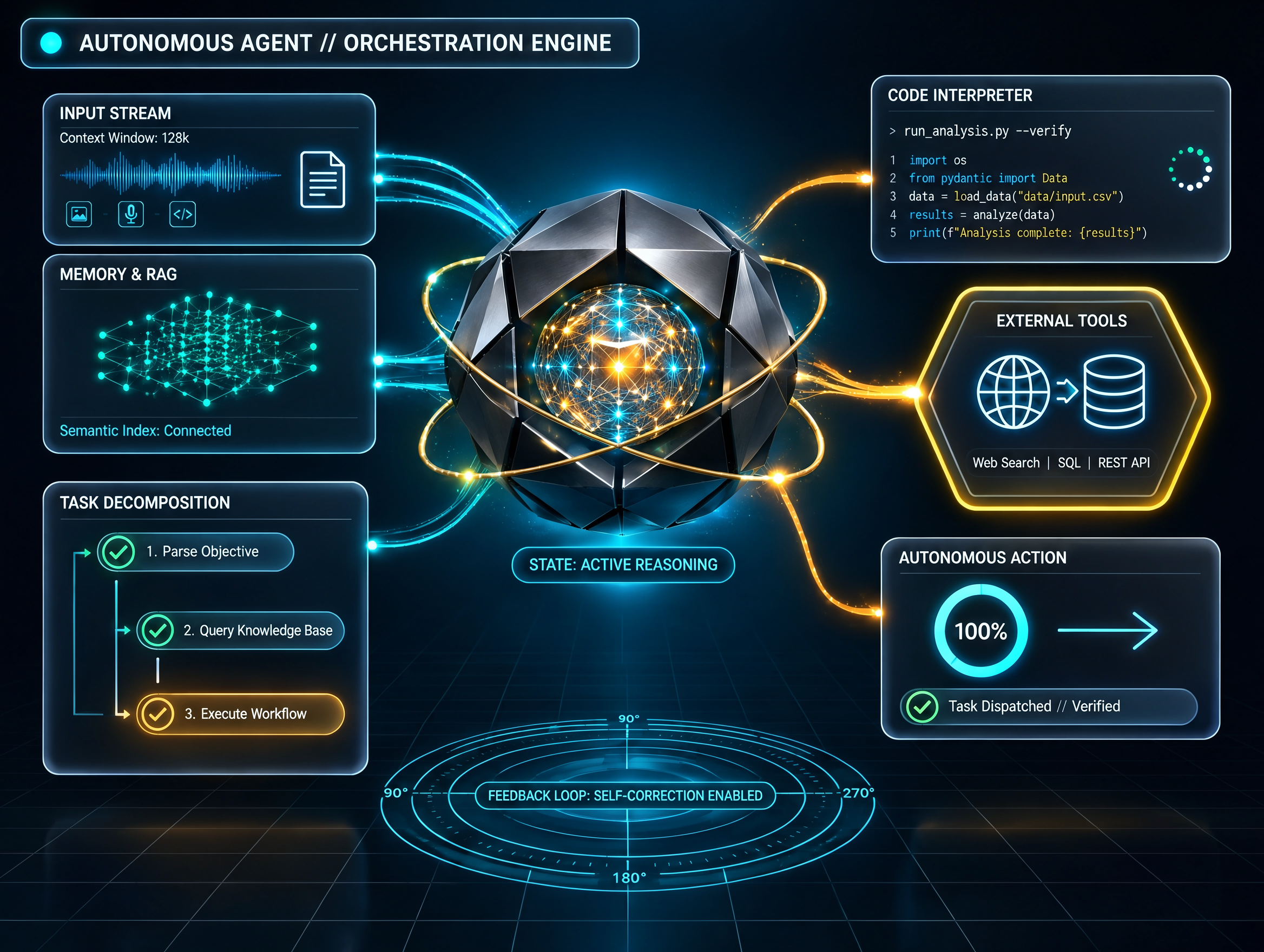
For the past few years, most of us have used AI as a very well-read assistant. You ask a question, it gives a helpful answer, and then you do the work. That’s starting to change. AI is moving from advising to doing, and businesses everywhere are starting to feel the shift.
From rules to agents: What’s actually changed
Software has come a long way. Traditional rule-based software works like a vending machine. It follows instructions written in advance, and when the situation changes, it can’t adapt. Language models were a big step forward. They can read, reason and write in everyday language, like a knowledgeable colleague. But they’re sealed off from other systems, so they can give advice but can’t get anything done.
An AI agent is the next step. It’s the same kind of model, but it has tools and permission to use them. It can look things up, make decisions, update records and work through a series of tasks it plans itself until the goal is met.
The key point is that the difference isn’t intelligence; it’s access. What’s changed recently isn’t how well models think. It’s what they’re allowed to connect to and act on.
That shift has happened fast. In 2023, models learned to call tools. In late 2024, the Model Context Protocol (MCP) gave agents a standard way to connect to business systems, and in 2025 a new protocol (A2A) let agents talk to each other. By April 2026, agents were completing 66% of real computer tasks on the OSWorld benchmark, up from just 12% a year earlier.
Why now, and where’s the ROI?
Three things have come together. Agents are now reliable enough for supervised use. Traditional robotic process automation has reached its limits on exception-heavy work. And standards such as MCP are cutting the cost of integration.
The biggest opportunity is in messy, judgement-heavy work that rigid scripts can’t handle. Agents can take on more volume without extra headcount, while people move into supervising and handling exceptions.
Take energy monitoring. An agent watches meter data, spots an anomaly, works out the likely cause and raises a work order for a person to approve. Success is measured in practical business terms: energy cost against a baseline, time from alert to fix, and the share of alerts resolved without anyone stepping in. For any use case, a fair business case should also count the costs of model usage, integration and human review.
A fast-growing global market
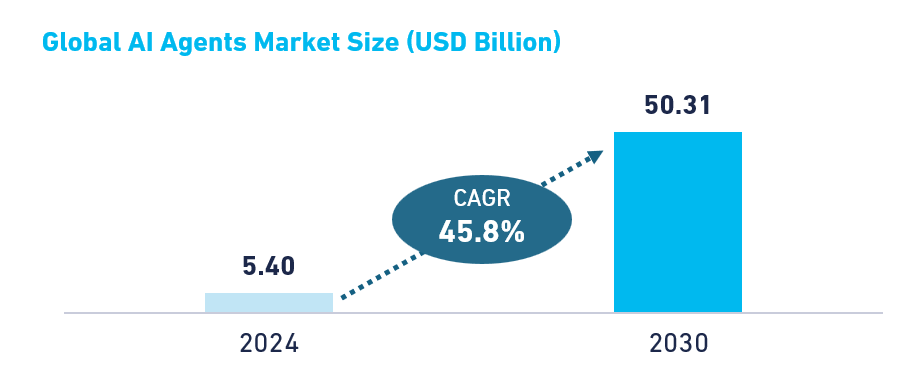
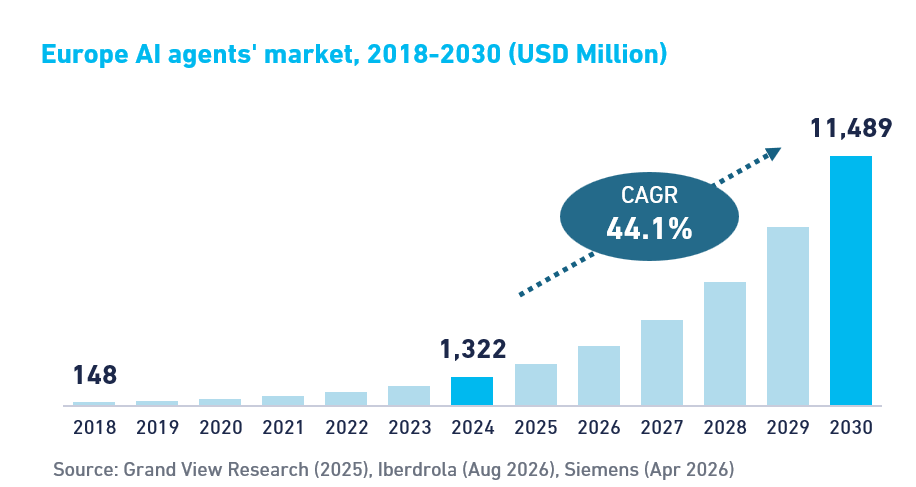
The global AI agents’ market is forecast to grow from US$5.4 billion in 2024 to over US$50 billion by 2030, almost nine times larger. Europe accounts for about a quarter of that market and already shows what adoption looks like at scale. In one survey, 44% of firms said they already deploy AI agents, and companies from energy to manufacturing are running agents in live operations.
How an agent works
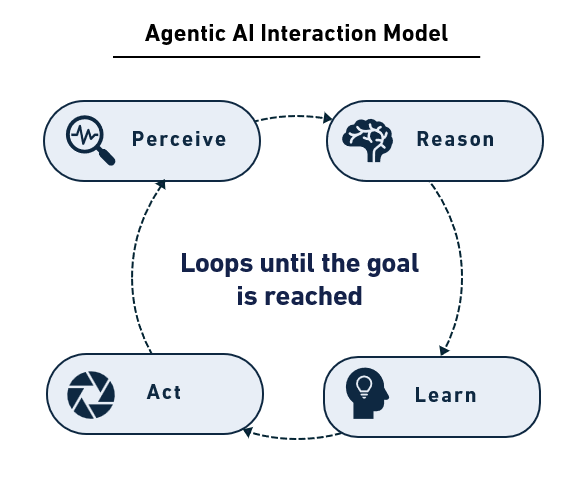
A single agent pursues one goal by working through a continuous loop:
- Perceive: takes in the goal and its context from chat, email, files, APIs and company data.
- Reason: a large language model plans and chooses the next step.
- Act: calls tools, systems and APIs to get the work done, with human approval where it’s needed.
- Learn: remembers what happened and improves over time.
Beneath that loop sits the foundation that makes agents fit for business. That means agent frameworks, observability so every step can be traced, guardrails such as permissions and audit logs, and the cloud infrastructure that runs it all.
Use Cases: Agents already at work
This isn’t theory. Organisations globally are already seeing measurable results.
- Amazon Q Developer takes on one of IT’s most tedious jobs: upgrading legacy Java applications. The agent scans the code, plans the migration, rewrites code and configuration, tests the result and corrects itself before a human reviews it. Thousands of applications have been migrated, upgrades that took days now take hours, and the reported efficiency gain is around US$260 million.
- Klarna’s AI assistant handles routine customer requests such as refunds and changes to payment plans. It verifies the customer, carries out the request and confirms the outcome. In its first month, it handled 2.3 million conversations, about two-thirds of all customer service chats and the equivalent work of more than 700 human agents, while keeping customer satisfaction steady.
- Siemens’ Eigen Engineering Agent tackles a shortage of skilled automation engineers. It generates and validates factory automation (PLC) code from plain-language requirements. It has been piloted with more than 100 customers across 19 countries, with up to five times faster execution and 50% greater efficiency.
When one agent becomes a team
As tasks get more complex, a single agent eventually hits its limits. Multi-agent systems split the work among specialists. A coordinator agent breaks a request into sub-tasks and routes each one to the right specialist. One agent might research, another analyse and a third carry out the final action, all sharing the same context. Underneath, access controls limit what each agent can see, and every step is logged for audit and governance.
This approach brings real benefits:
- Higher accuracy: each agent has a narrow focus, which means fewer errors.
- Multimodal handling: emails, PDFs, images and calls each go to the right specialist.
- Resilience: you can upgrade or replace one agent without rebuilding the whole system.
Two deployments show what this looks like in practice.
- At Moody’s, specialist agents work in parallel to verify company data, extract filings and assess risk, then combine the results into one sourced credit memo. A task that used to take an analyst 40+ hours now takes about two to three minutes.
- BBVA’s banking assistant uses a routing agent to identify what a customer wants and pass it to one of more than 150 specialist agents, each built for a specific banking operation. Together, they cover over 3,000 potential customer questions.
There is a catch, though. More agents mean more cost, more delay and more coordination. The best approach is to start with one agent and split the work only when a single agent can no longer cope.
The innovators to watch
Investment is pouring into the space. Europe’s top 50 AI agent start-ups have raised a combined US$8.4 billion, and European AI start-up funding rose 130% to US$23 billion in the first half of 2026 alone. The leading players are building tools for businesses everywhere:
- Lovable (Sweden): builds web applications from natural-language instructions.
- Legora (Sweden): an agentic workspace that automates legal review and drafting.
- Wonderful (Netherlands): multilingual agents that automate enterprise customer support.
- ElevenLabs (UK): realistic, multilingual voice synthesis.
- Parloa (Germany): a platform for managing AI agents in enterprise customer service.
Beyond these, younger companies are going after specific business problems. 2501.ai in Paris deploys specialist agents that investigate and fix IT infrastructure incidents themselves across cloud, on-premises and hybrid environments, rather than just raising alerts. Agaton in Stockholm analyses how customers speak as well as what they say, picking up on pace, confidence and hesitation to spot buying intent and churn risk, then turns those signals into coaching for sales teams. Alta in Tel Aviv uses coordinated go-to-market agents for prospecting, lead qualification and personalised outreach, backed by a US$25 million Series A led by Sumitomo Corporation.
Where these companies are based matters less than what they show us: agents can handle a wide range of everyday business work, wherever a business operates.
SCSK {digital} View: what this means for businesses
The case for AI agents is no longer theoretical. Agents are ready, investment is growing fast and the results are already showing in production. The real question for businesses is where to start and how to scale safely.
We see the strongest enterprise impact in four areas:
- Supply chain: agents coordinate orders, stock and shipping across connected companies.
- Sourcing: agents negotiate routine supplier contracts within agreed limits.
- Operations: agents work alongside plants and equipment, not as standalone software.
- Governance: agents run with audit trails, data controls and human approval built in.
Large enterprises with end-to-end reach have a particular advantage. When everything from raw materials to retail sits within one group, agents can cover an entire value chain. Long-standing relationships with suppliers and customers make adoption easier. And once one agent design has proved itself, it can be rolled out across many group companies and markets, with permissions and oversight adapted to local rules.
Our advice is simple: start small and keep people in charge.
- Start with one process: choose high-volume, exception-heavy work and prove the return before scaling.
- Keep a human in the loop: supervised agents work well for pilots, and autonomy can grow as the infrastructure matures.
- One agent first: move to multiple agents only when the work naturally splits into parallel parts.
- Partner rather than build: start-ups and hyperscalers offer ready-made agent sandboxes and capabilities, so buying usually beats building in the early stages.
SCSK {digital} can support you in three steps. Prove the business case by quickly prototyping agents with your real data. Pilot with a time-limited proof of concept and agree on return-on-investment measures up front. Scale with governance ready for regulations such as the EU AI Act and the rules in each market you operate in.
The AI workforce has arrived. The businesses that benefit most won’t be the ones that automate everything at once. They’ll be the ones that start with a clear purpose, measure what matters and grow with confidence.
Sources
- https://www.mckinsey.com/capabilities/quantumblack/our-insights/seizing-the-agentic-ai-advantage
- https://hai.stanford.edu/ai-index/2026-ai-index-report
- https://www.leanix.net/en/download/agentic-ai-survey-2026
- https://dealroom.co/lists/ai-agent-startups-europe/
- https://www.grandviewresearch.com/industry-analysis/ai-energy-market-report
- https://www.iberdrola.com/press-room/news/detail/iberdrola-presents-cases-artificial-intelligence-the-eleventh-edition-digital-summit
- https://www.geeksforgeeks.org/artificial-intelligence/agentic-ai/
- https://learn.microsoft.com/en-us/azure/foundry/agents/overview?spm=a2ty_o01.29997173.0.0.3ce155fbsNfyQM 1
- https://www.anthropic.com/engineering/building-effective-agents
- https://x.com/ajassy/status/1826608791741493281
- https://www.klarna.com/international/press/klarna-ai-assistant-handles-two-thirds-of-customer-service-chats-in-its-first-month/
- https://press.siemens.com/global/en/pressrelease/siemens-launches-eigen-engineering-agent-bringing-purpose-built-ai-industrial
- https://www.moodys.com/web/en/us/media-relations/press-releases/moodys-brings-credit-and-compliance-workflows-directly-into-anthropics-claude.html
- https://www.bbvaaifactory.com/specialized-ai-agents-in-an-ai-assistant/
- https://www.anthropic.com/engineering/multi-agent-research-system
- https://digital-strategy.ec.europa.eu/en/library/agentic-ai-leveraging-european-ai-talent-and-regulatory-assets-scale-adoption
- https://www.grandviewresearch.com/industry-analysis/ai-agents-market-report
- https://dealroom.co/resources/european-ai/
- https://www.eu-startups.com/2026/05/meet-the-top-10-european-startups-powering-the-agentic-ai-boom/